Urban Renewal sought to revitalize cities by demolishing “slums” and “blighted” neighborhoods, and to replace them with new housing, shopping, and entertainment districts. Enticing private developers to buy cleared land and build on it was a hard job, particularly in small cities with ambitious redevelopment plans. A 1975 national study found that, even ten years after the start of an Urban Renewal project, about 20% of the cleared land had yet to be sold to developers.
The first step in the land disposition or sale process was to assemble the small, cleared parcels into large parcels packaged to entice developers. Typically, some land was set aside for public use: schools, public housing developments, government office buildings, etc. But most of the land was earmarked for sale to private developers at a steep discount, which amounted to a massive land acquisition subsidy for developers.
In Newburgh’s two projects, for example, the city spent a total of $12.5 million to acquire land, relocate residents, demolish buildings, and assemble the land into large disposition parcels. The city then priced the 125 acres of cleared land for resale to developers at about $1.1 million, about $9,000 per acre. Some 20 to 30 acres remain vacant today. Newburgh’s inability over the past fifty or more years to sell all of its cleared land was part of a general pattern. Because of the long project schedules–often ten years from planning to land disposition–developers’ financial models broke down as construction and borrowing costs skyrocketed in the late 1960s and 1970s.
The exception to this was New York City during the Robert Moses era. Moses preselected site sponsors before obtaining federal and state Urban Renewal funds. Moses tended to favor nonprofit or limited profit sponsors. This strategy guaranteed that the city’s renewal projects would redevelop the land as intended. No other city in the state (or country, for that matter) could get federal permission to preselect a site sponsor.
Smaller cities with ambitious renewal plans often found that they could not entice private developers to help them attain their redevelopment goals. In Geneva, for example, in 1966 two businessmen offered to buy three disposition parcels set aside for commercial use. They planned to build a motel, supermarket, department store, smaller shops, along with underground parking. However, negotiations between the city and the partners dragged on for another three years, before falling apart for good in 1969.
Other locations around the state had similar problems, despite aggressive advertising campaigns. Peekskill and Plattsburgh, for example, blamed high interest rates and the 1973-74 energy crisis for their inability to sell their disposition parcels. By 1976, Plattsburgh had succeeded in selling only two of ten disposition parcels, with a third in negotiation.
In general, cities with more modest redevelopment goals succeeded in meeting them. Smaller shopping centers anchored by a grocery store or branch bank were more realistic options than large indoor or pedestrian malls. Hornell, for example, built a new motel and movie theater. Ilion’s major redevelopment was a small mall anchored by a local drug store.
Urban renewal projects often involved the construction of arterial highways. In cities like Buffalo, Rochester, and Syracuse, these urban expressways cut through or isolated existing neighborhoods, aggravating the damage urban renewal did to families and communities. Buffalo’s Kensington Expressway and Scajaquada Parkway both cut through the city's historic Olmsted Parks System and effectively segregated the predominantly African American East side. Expressways in Syracuse likewise targeted the African American community, which was concentrated in the city's 15th Ward.
But highway construction appealed to city officials because of perverse financial incentives: the state Department of Transportation (NYSDoT) paid for the entire cost of arterial construction, but the municipality could use the entire amount as part of its share of the cost of an urban renewal project. In Kingston, for example, the arterial allowed the city to avoid paying about $900,000 back to the federal government. Yet this financial windfall for the city came with human costs. About 100 households were displaced for Kingston’s arterial.
In the 1960s and 1970s, indoor or pedestrian malls seemed to be the key to revitalizing downtown. Many malls succeeded for a few years but ultimately failed. Of 200 downtown pedestrian malls built nationally between 1959 and the early 1980s, 7 out of 8 of them have been torn down.
Consultants promised Olean officials that a new mall, to replace its demolished downtown, would draw shoppers from a four-county catchment area and generate $300 million in annual sales. The mall opened in 1977, but sales began to drop off in the 1990s because of competition from outlying retail centers. Today, the mall is largely vacant.
Niagara Falls built Rainbow Centre to attract Canadian shoppers and vacationers. It too was successful for several years after its 1982 opening, but by 2000, the only business remaining was an off-track betting parlor.
Amsterdam opened an 80,000 square foot mall to great fanfare in 1977. Yet by the end of the century, retail activity had stopped. Part of the mall is now office space.
Ogdensburg’s mall opened for business in 1973. The agency proudly reported to the state that this represented “the greatest amount of visible progress in the history of the Ogdensburg Urban Renewal Agency.” Today it is largely vacant.
The Galleria at White Plains, a 900,000 square foot mall, opened in 1980 on urban renewal land, anchored by Macy’s and Sears. The COVID pandemic and fears about crime led to its closure in 2023.
Troy’s Uncle Sam Atrium, a 220,000 square foot indoor mall, experienced the same fate. It finally opened for business in 1978, some five years after 120 buildings had been razed for it. Today it is slated for closure and demolition. Its owner, David Bryce, told a reporter in 2021, “It’s outlived its useful life. It’s so out-of-date now.”
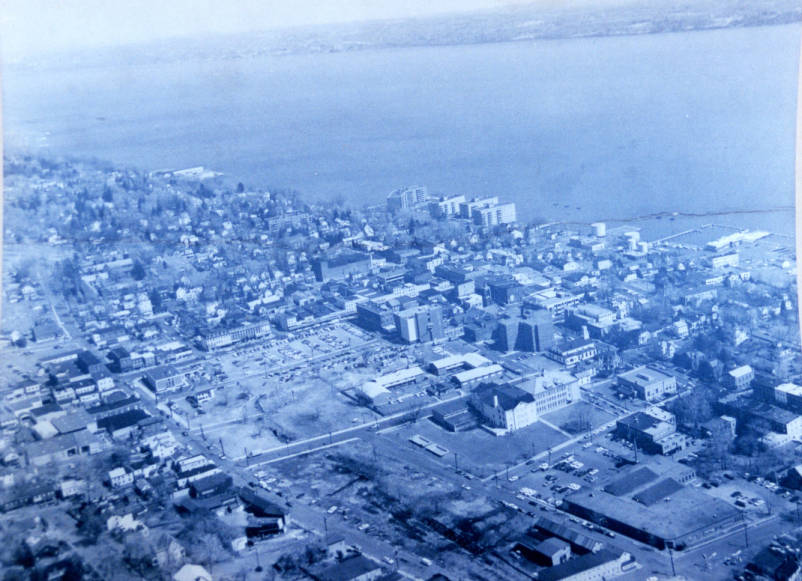
Aerial view of Nyack, NY
This view of Nyack shows the blocks in the center of the village which were cleared for Urban Renewal. The senior housing is in place and the Liberty Street School is still standing. On the waterfront, the Standard Oil tanks are standing and there is a large marina at the foor of Main Street. It's a village in the midst of changes.
Courtesy of Nyack Library
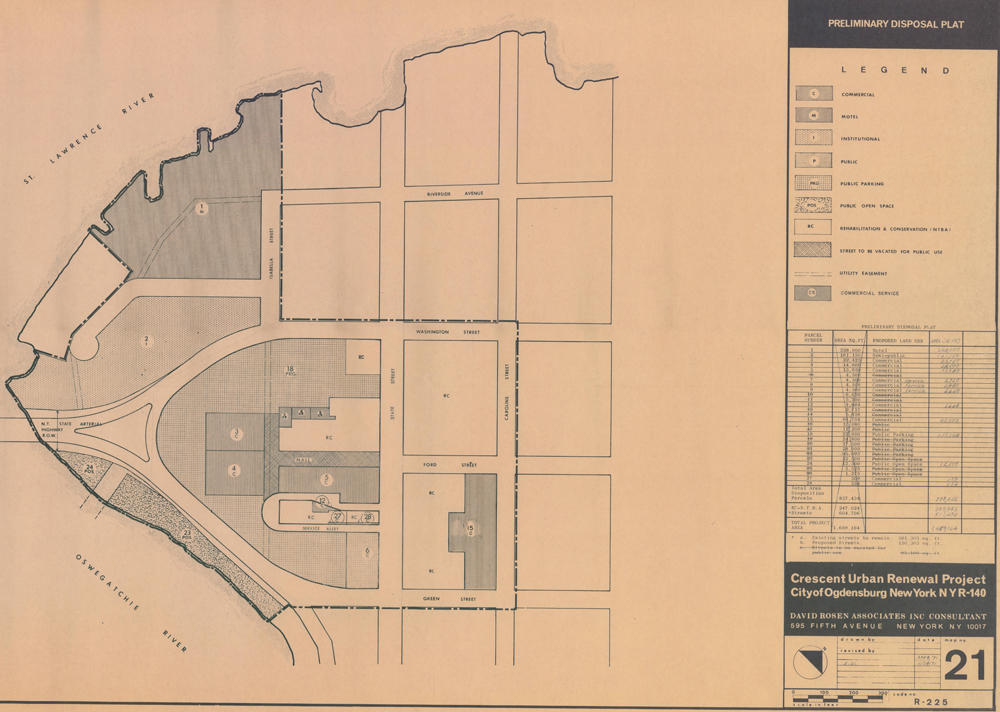
Map of disposition parcels for Ogdensburg’s Urban Renewal project.
Courtesy of Julie Madlin, Ogdensburg City Historian
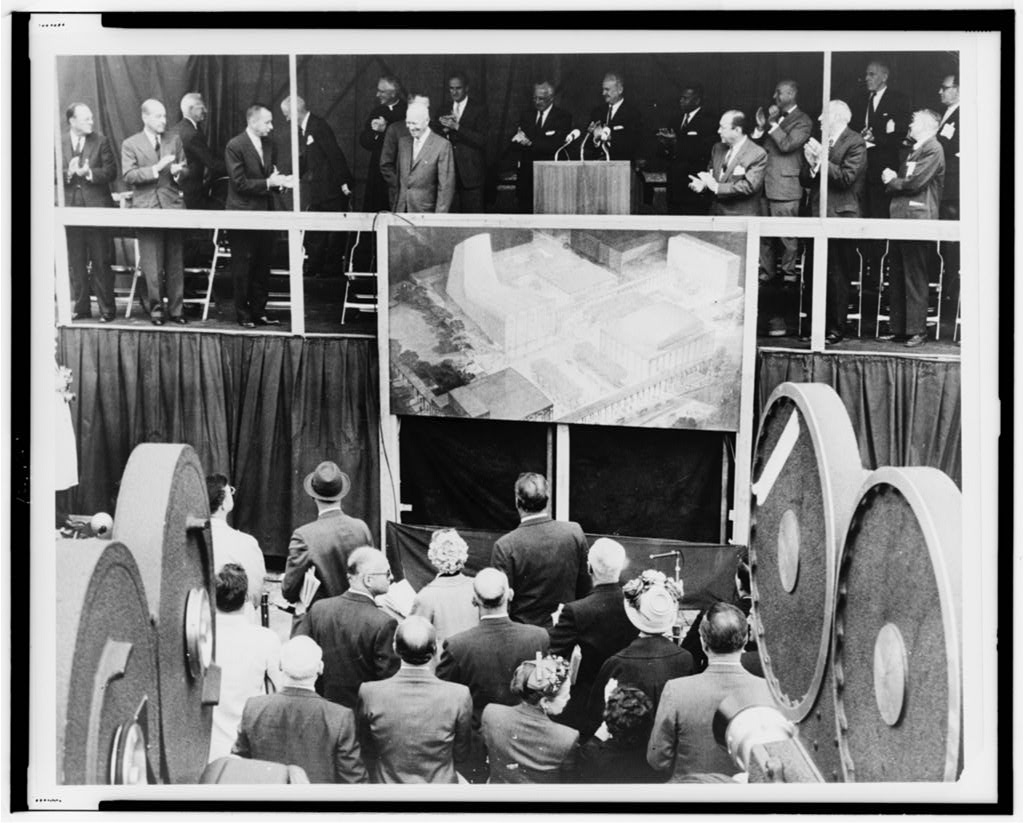
Dedication ceremony for Lincoln Center, 1959. President Eisenhower is just to the left of the lectern.
World Telegram & Sun photo by Ed Ford. Courtesy of the Library of Congress
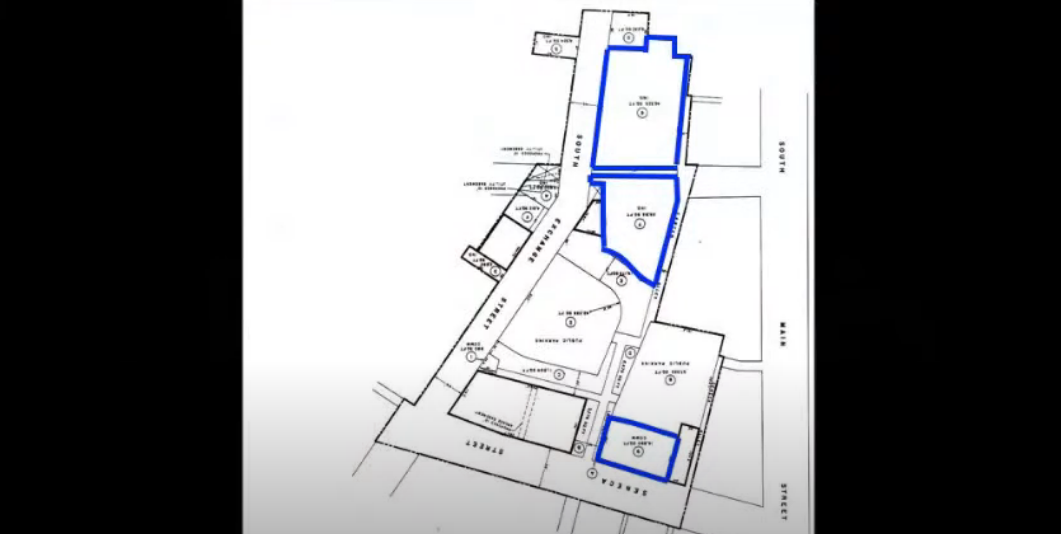
A video by Historic Geneva discussing problems with land disposition.
Courtesy of Historic Geneva
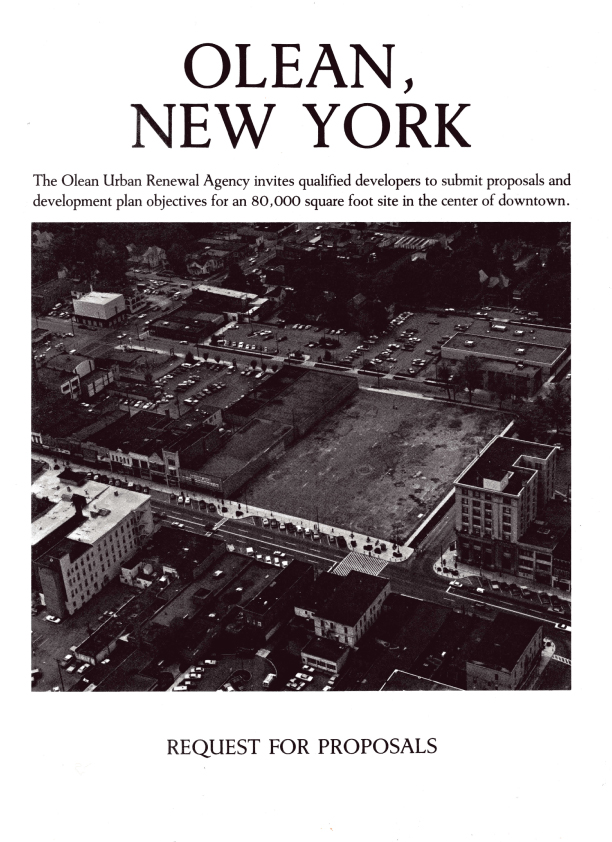
A 1983 request for proposals issued by Olean Urban Renewal Agency for an unsold disposition parcel.
Courtesy of Olean Urban Renewal Agency Records
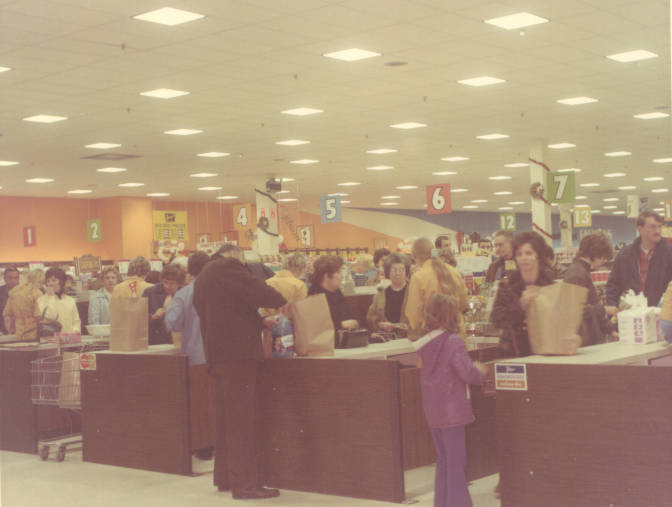
View From Inside Fay's Drug Store After Urban Renewal
The anchor store of Fay's Mall, Fay's Drug Store, was very busy shortly after its grand opening with many customers in the checkout lines paying for merchandise.
Courtesy of Ilion Free Public Library
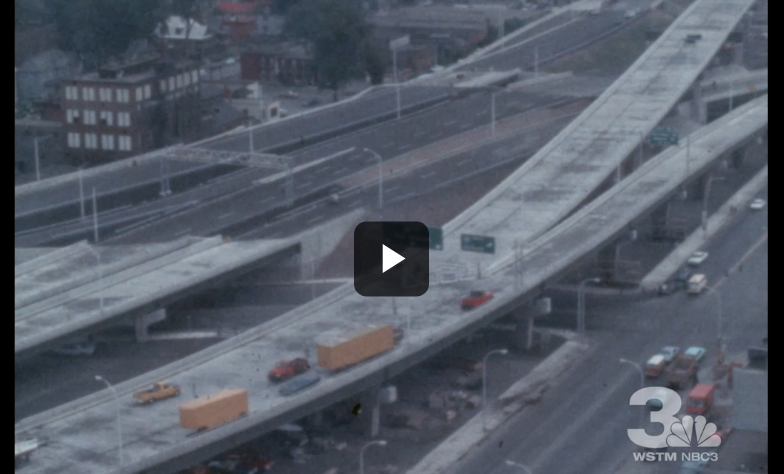
Construction work on the Onondaga Interchange, Syracuse, 1968, from a WSYR Channel 3 broadcast. The segment begins at 1:17.
Courtesy of Onondaga Historical Association
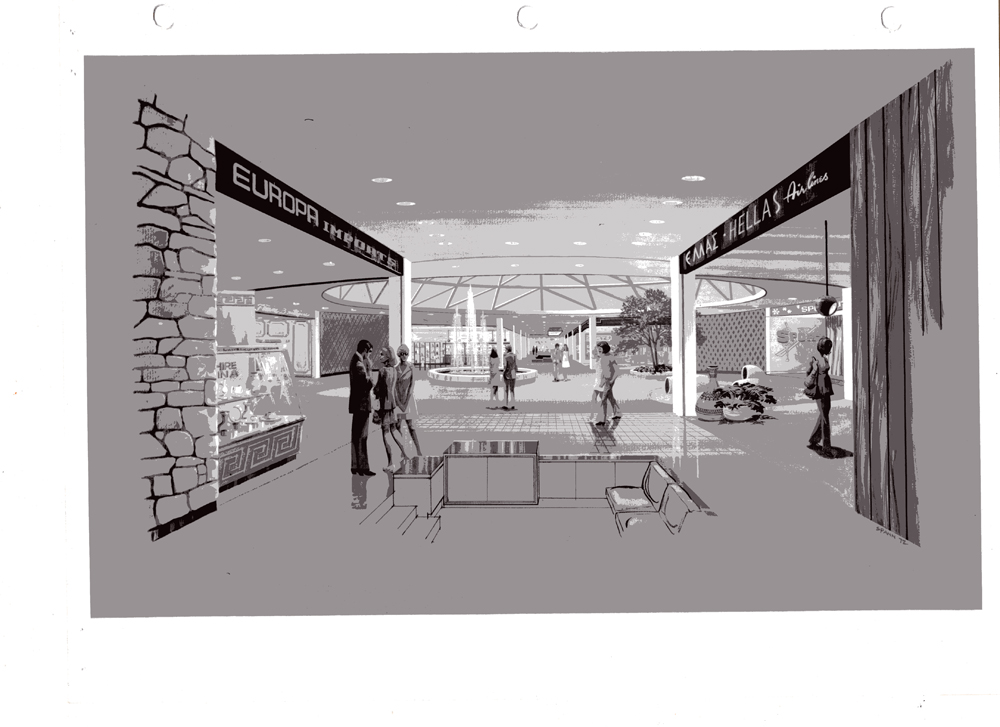
Artist rendering of a possible interior of Olean’s indoor downtown mall.
Courtesy of Olean Urban Renewal Agency Records
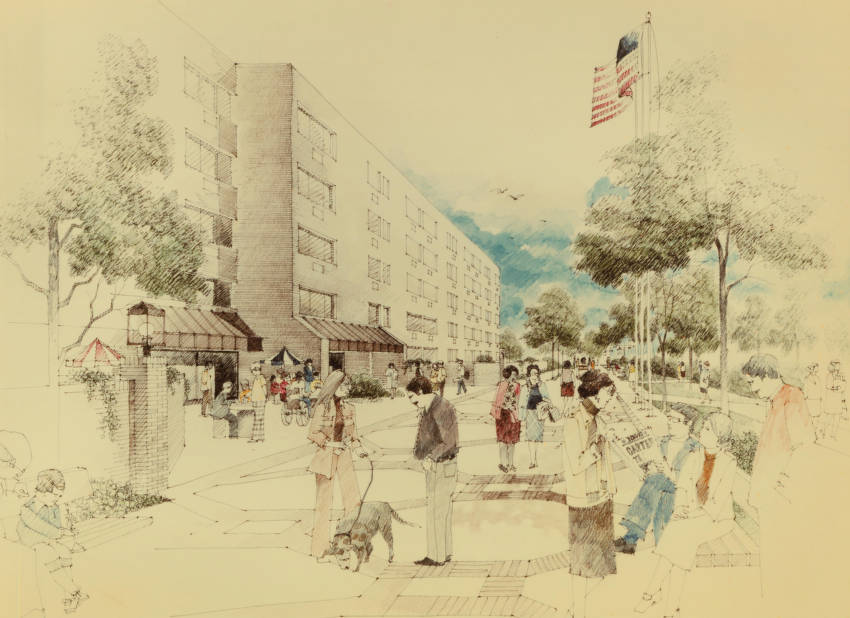
Nyack Plaza pedestrian easement. In this architect's drawing, residents of Nyack Plaza gather in the pedestrian area to walk, talk, sit, and read. Construction of the project began in January 1978 and families began moving into the apartments in November of 1980. The 174-unit apartment complex was approved by the NyackUrban Renewal Agency.
Courtesy of Nyack Library
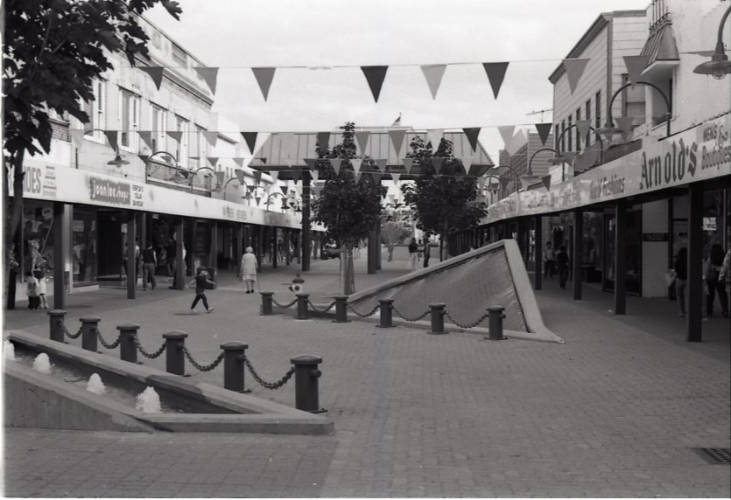
Black and white photograph of the Freeport Mall. For a period of time, Main Street was closed to traffic and open for shoppers. It opened in 1977.
Courtesy of Freeport Memorial Library and Freeport Historical Society & Museum
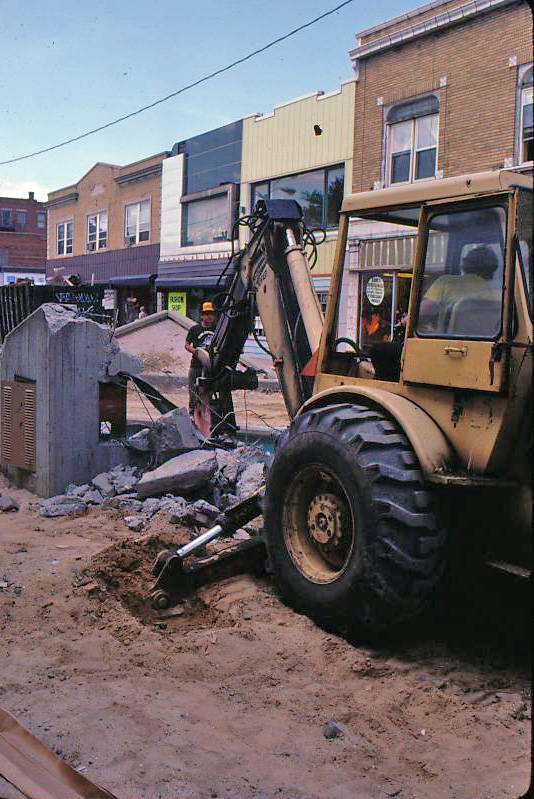
Freeport Mall being demolished in 1987, ten years after its opening. South Main Street was reopened after the demolition.
Courtesy of Freeport Memorial Library and Freeport Historical Society & Museum
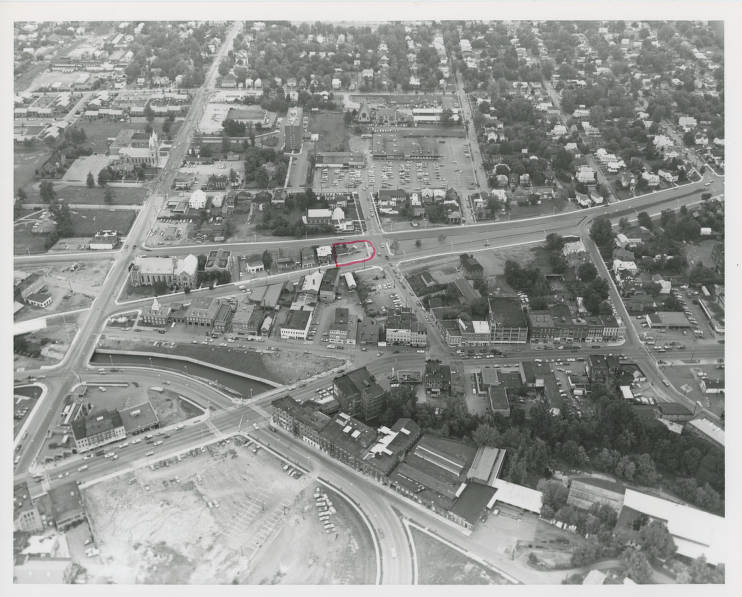
Cleared Urban Renewal land in Auburn in 1976. The new arterial highway runs left to right. The open lot in the bottom left of the image is the current location of Wegmans, a former factory site. About 200 structures were demolished in Auburn for Urban Renewal. The land cleared for Urban Renewal sat vacant until it was sold to Wegmans at a cut rate.
Courtesy of the Cayuga Museum of History and Art