On July 15, 1949, President Harry Truman signed into law the Housing Act of 1949. He promised “decent homes in wholesome surroundings for low-income families now living in the squalor of the slums.”
Instead of addressing the housing crisis, Urban Renewal is known for displacing families and hollowing out downtowns during its 25-year existence. In the hands of local officials, the program focused on revitalizing downtown commercial districts and boosting property tax revenue.
Many of the residents Truman had hoped to help were instead hurt by the loss of homes, businesses, and community institutions. By the end of the program in 1974, targeting and clearance of Black and Puerto Rican neighborhoods had made segregation and overcrowding worse.
The scale of urban renewal across the nation was staggering:
- Over 1,200 villages, towns, and cities undertook 3,300 projects.
- 1.3 to 1.5 million people were forced to move. 60% were Black and 2/3 were renters.
- All levels of government (federal, state, local) spent a total of $20 billion.
- 156 square miles of urban land were cleared.
- 280,000 buildings, containing 450,000 residences, were torn down.
- 114,000 small neighborhood businesses were forced to move.
It was a massive program in New York State as well:
- 91 villages, towns, and cities undertook about 250 projects.
- About 160,000 people were forced to move. Half were Black, even though the state’s population was 87% white.
- All levels of government (federal, state, local) spent a total of $2 billion.
The number of people and businesses forced to move are likely doubled if urban expressway construction, a related program, is included.
Urban Renewal projects proceeded in three stages:
- Planning: When a municipality decided to embark upon a renewal project, it hired planning consultants. These consultants promised that urban renewal projects would eliminate slums and prevent their recurrence, revitalize downtown commercial areas, and increase property taxes.
- Execution: Once a municipality finished the planning stage, it applied to the federal government for funds to carry out its plans. The vast majority of Urban Renewal activities took place during this stage, including acquisition of properties via eminent domain, relocation of residents and businesses, demolition of structures, and the assembling of cleared land into large redevelopment parcels.
- Disposition: Once a project area was cleared, the municipality marketed the land to private developers. Although some land was often set aside for local public housing authorities and other municipal agencies, the program was a massive land acquisition subsidy for private developers.
Urban renewal projects did little to help inner-city residents, instead causing harm to their communities. These projects reinforced housing segregation for families of color and made it more difficult for them to build intergenerational wealth. The loss of community ties could prove as damaging psychologically as financial losses. This phenomenon is described by psychiatrist Mindy Fullilove as “root shock.”
Today, some community activists and elected officials are beginning to discuss reparative justice for the families harmed by urban renewal.
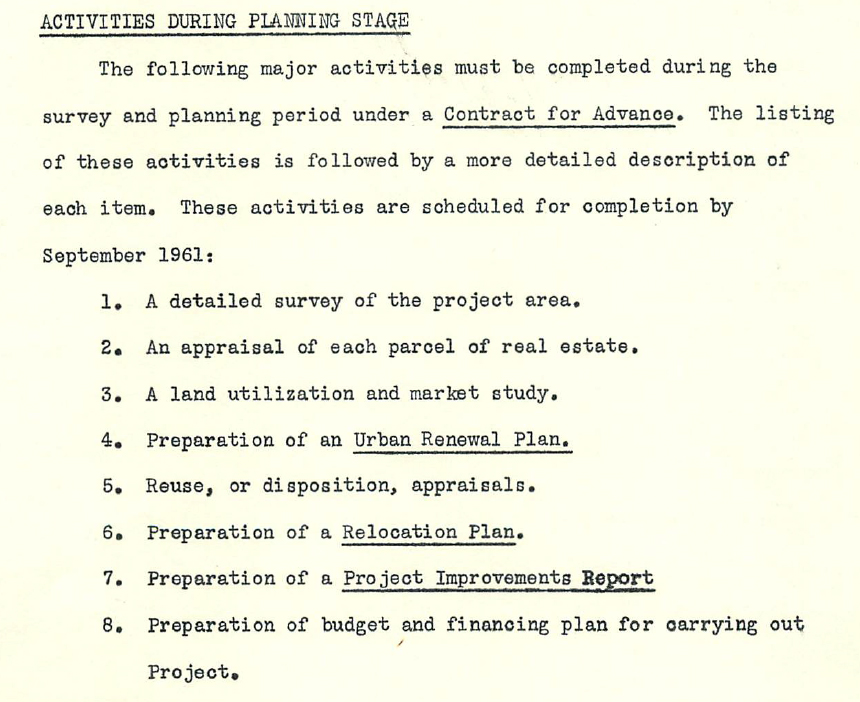
This excerpt from the White Plains Urban Renewal project lists the mandated activities during the planning phase. It includes a survey, an appraisal of each real estate parcel, a market study, a formal plan for Urban Renewal, disposition appraisals, a Relocation Plan, a Project Improvement Report, and a financing plan.
From Kenneth Allebach's “Urban Renewal Program Guide and the Central Renewal Project,” Jan. 1961, p. 11.
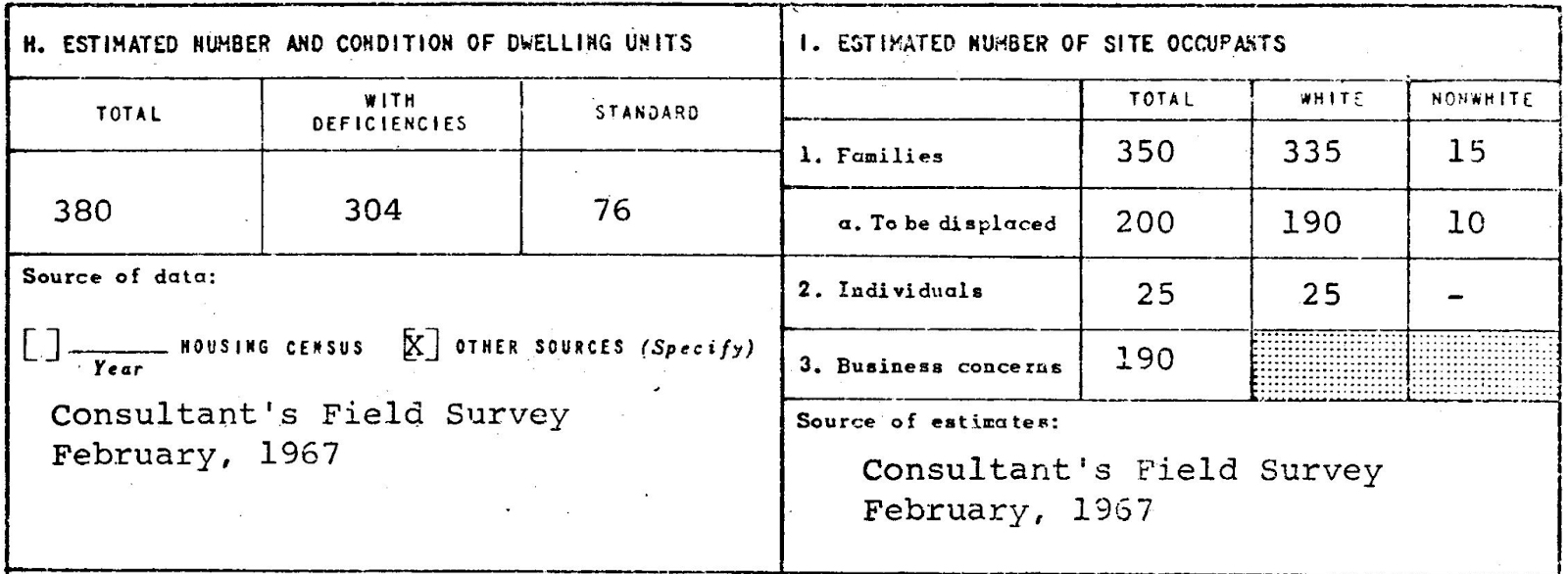
This excerpt from the Glens Falls consultants' reports shows the extent of planned demolition, with a summary table of families, individuals, and businesses that would have to relocate. Families and individuals were tallied as a total and separated as white or nonwhite. In Glens Falls in 1967, according to this excerpt, 10 of the estimated 200 families to be displaced were nonwhite, or 5%. In 1960, Glens Falls had 150 nonwhite residents of more than 18,000 residents in total, or <1%.
From Candeub, Fleissig, and Associates, “Survey and Planning Application: Downtown West Urban Renewal Project,” 1967.
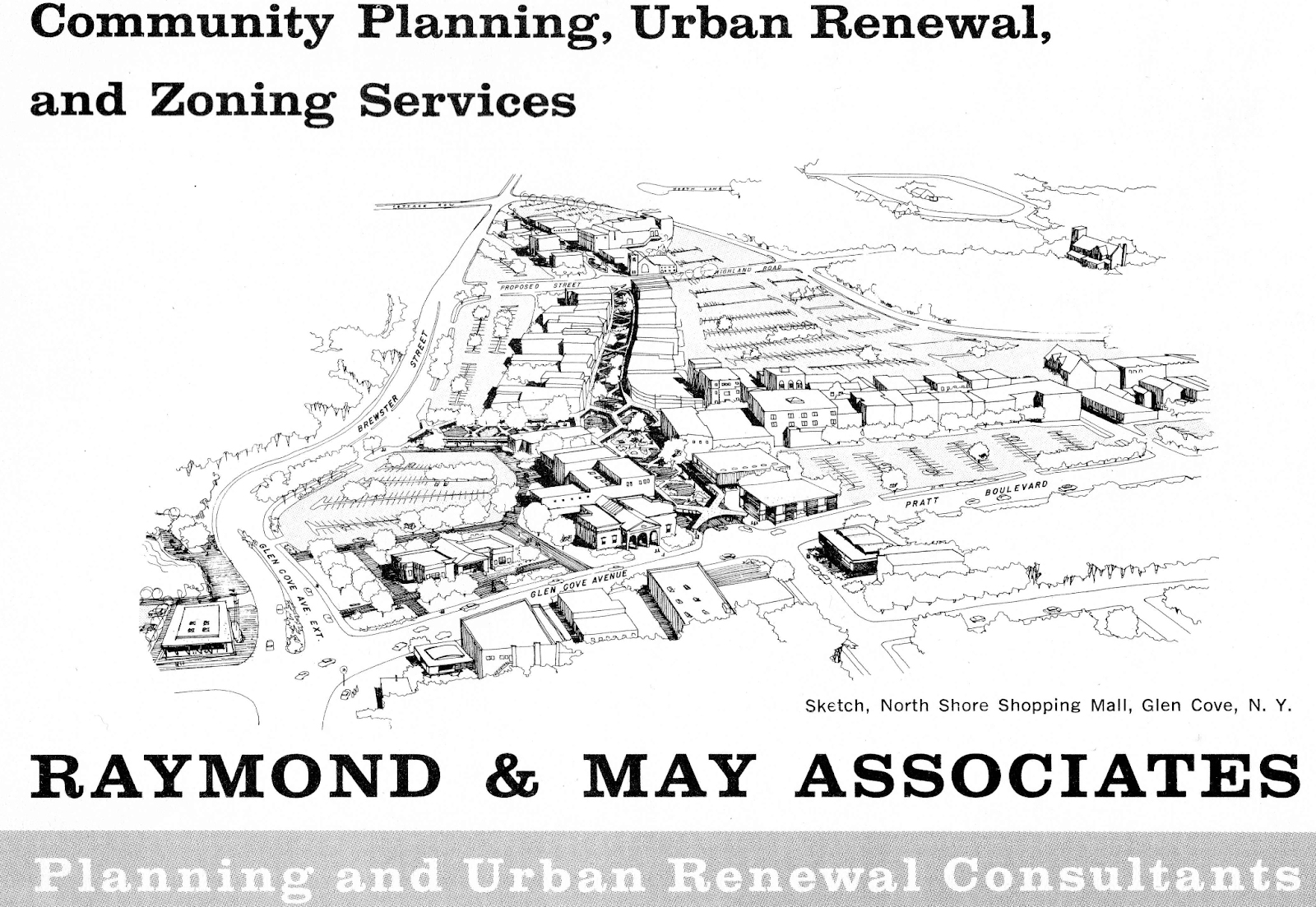
Cover of the brochure of Raymond & May Associates, marketing their urban renewal planning services to municipalities around the Northeast.
Courtesy of the City of Kingston's Urban Renewal Agency Records
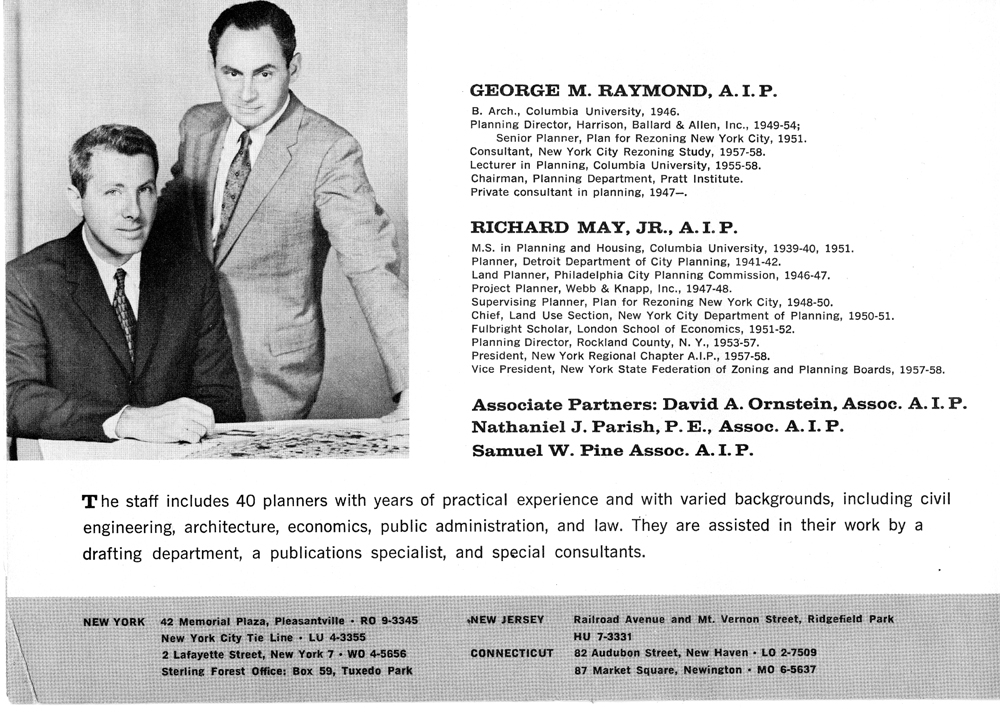
Inner page from a brochure of Raymond & May Associates, marketing their urban renewal planning services to municipalities around the Northeast. The consultants hired to run these largescale projects around New York State were often white men with advanced degrees, a typical indication of privilege in the 1960s.
Courtesy of the City of Kingston's Urban Renewal Agency Records