The U.S. Constitution and the New York State constitution both provide for the power of government to exercise eminent domain: the acquisition of private property for public benefit. Before the Urban Renewal Era, this generally meant that the seized property would be put to public use directly, like a road, school, post office, etc. A 1954 U.S. Supreme Court decision (Berman v. Parker) expanded this definition to include the seizure of private property for Urban Renewal projects.
Thus, municipal agencies could acquire private property, even though that property would ultimately be sold to another private owner. Eminent domain was now a tool for economic redevelopment rather than a tool for improving housing conditions for the poor and working class.
Owners were supposed to receive just compensation for their properties. Just compensation was based on fair market value as determined by independent appraisals. Fair market value was the price arrived at by a willing seller and an informed buyer. But in the case of urban renewal, very few sellers were willing, and housing discrimination, redlining, and predatory lending practices depressed values even further.
Several aspects of urban renewal blocked owners from receiving full value for their properties.
First, the lengthy delays of the Urban Renewal process often dramatically reduced property values. In 1972, appraiser Justus H. Schwaner described how this process played out in Newburgh. Renewal area residents and owners had known since 1956 that city officials were planning an Urban Renewal project in their neighborhood. From their perspective, “the only safe thing to do was to get out,” thus precipitating “a sharp decline in property values” as everyone tried to sell.
Second, discriminatory lending practices often reduced property values. In the summer of 1963, Newburgh Evening News reporter Joseph Ritz found that most African American families were unable to get traditional bank mortgages, irrespective of their ability to pay or the location of the property they tried to buy. Furthermore, banks typically refused to write mortgages in the East End, where nearly all of the city’s Black population lived. One bank president rhetorically asked Ritz, “If you had money in our bank, would you want us to invest in a declining area?”
Finally, unable to secure traditional mortgages, many people of color and low-income families were subjected to a predatory practice known as the contract sale. These highly exploitative sales were common in low-income neighborhoods due to redlining. They were rent-to-own schemes where a buyer paid an inflated price to buy a home. The seller retained title to the property until the buyer made a specified number of payments (usually monthly for 12-15 years).
In this model, the buyer did not build up any home equity before the deed changed hands at the end of the contract. Over the years of the contract, it was the buyer who was responsible for all taxes, utilities, insurance, and repairs. If the buyer was late with a monthly payment, the seller could unilaterally cancel the contract, evict the buyer, and hold on to all the money paid to date. The seller could then find a new buyer and begin the cycle all over again.
Unlike traditional home sales, these land contracts were seldom publicly recorded. Thus, Urban Renewal officials were often unaware of these contracts, resulting in property acquisition payments going entirely to the seller, with the buyer receiving nothing. In 1968, economist Anthony Downs testified to Congress that fewer than half of contract buyers received compensation for property seized by state and local authorities.
A typical contract showed how this worked in practice. In 1955, John and Vivian Robinson signed a land contract to buy 45 Jefferson St. in Albany from real estate partners Sidney Albert and Irving Kirsch. The contract would convey the house to them on Oct. 1, 1968, provided they paid Albert and Kirsch $24 a month as well as the cost of all repairs, insurance, taxes, assessments, and water rents. Failure to make the monthly payments would mean cancellation of the contract. Because they built up no equity in the property, the Robinsons would lose any investment in improvements or repairs. At the end of thirteen years, the Robinsons could acquire the deed to 45 Jefferson for $8,200 at 6% interest, minus the total of their monthly option payments.
Of course, this was all moot after March 27, 1962, when the State of New York seized their house along with 1,150 other properties. Albert & Kirsch still held the deed. We know that the State appraised 45 Jefferson at $5,500 and that Albert & Kirsch agreed to a $6,000 reimbursement. However, we don’t know whether the Robinsons received any of this.
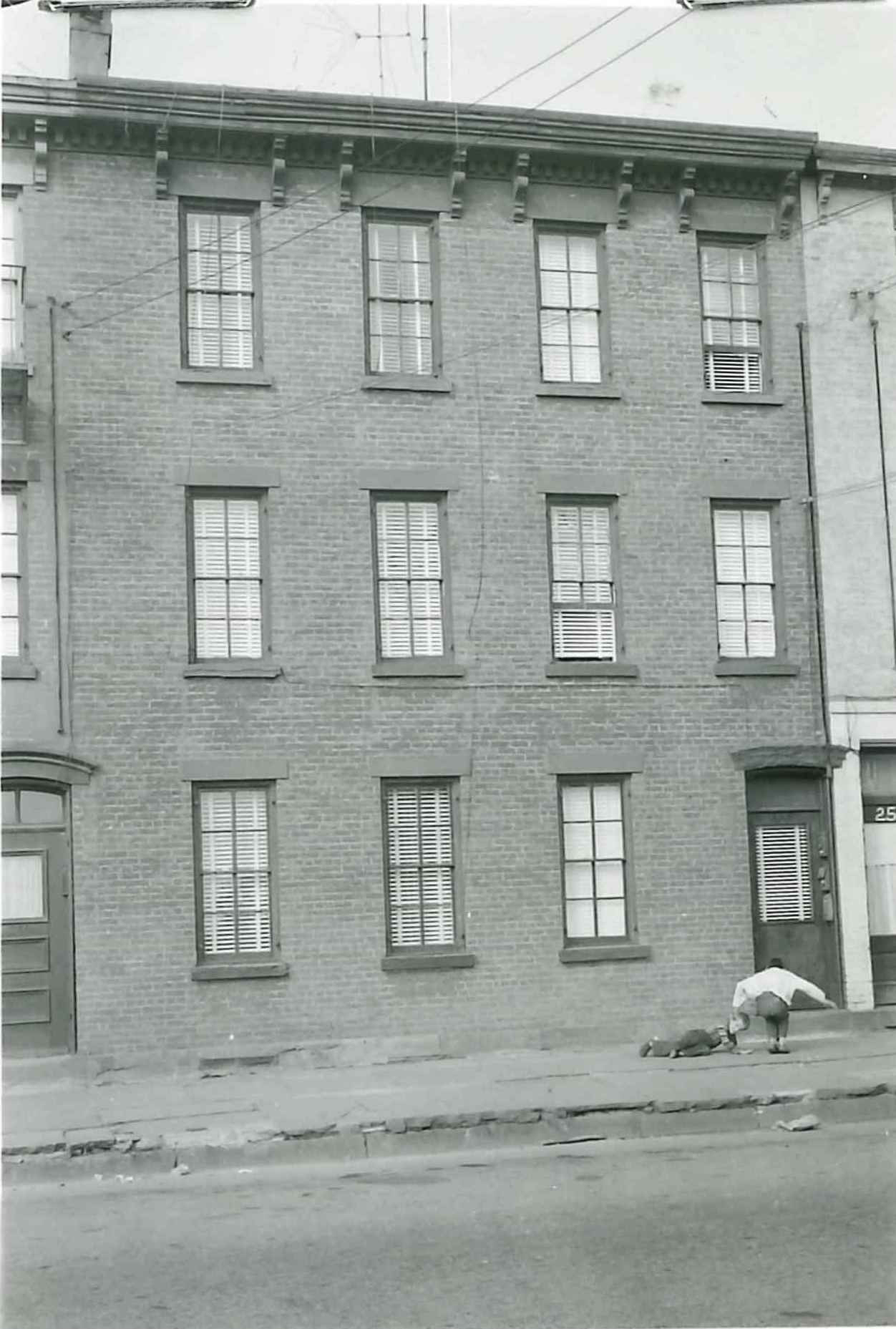
A 1958 appraisal photo of 257 Water St., Newburgh. Wilbur Higgins, Jr. and a friend are photographed playing outside. Wilbur’s parents bought the building in 1948.
Courtesy of the Newburgh Urban Renewal Agency Records
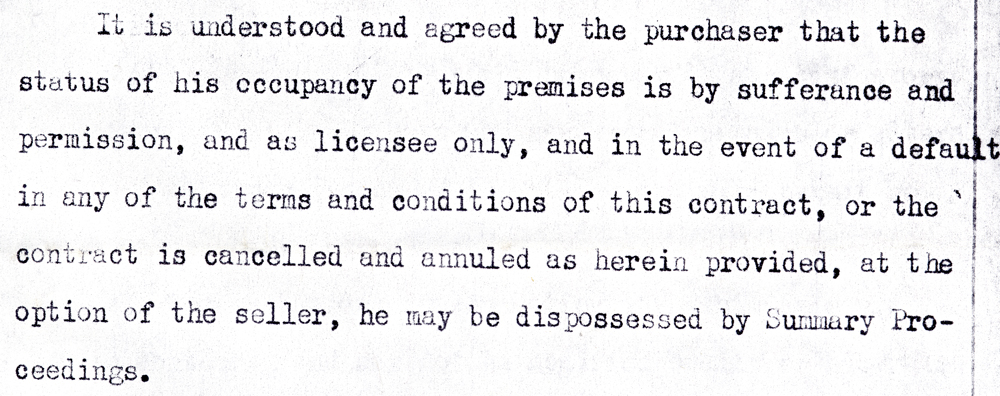
Extract from the land contract between seller Frank Clarino and buyer Carrie Wilson, outlining the terms in which the buyer could be dispossessed of the property.
Courtesy of the Newburgh Urban Renewal Agency Records
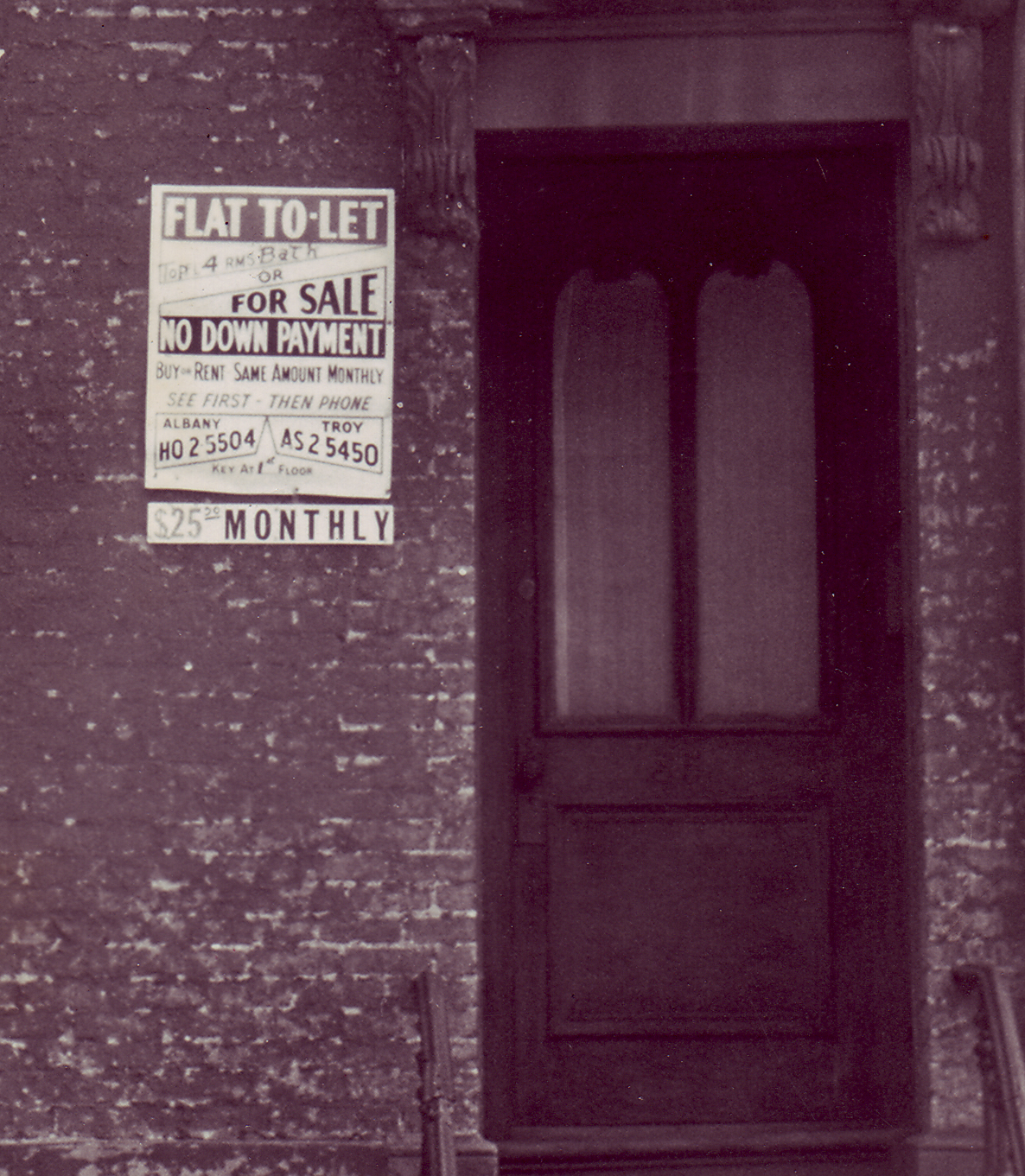
Albert & Kirsch sign advertising their contract sales, 35 Jefferson St., down the block from the Robinsons’ home.
Courtesy of the Albany Times Union