
Collection Facts
Historical Context
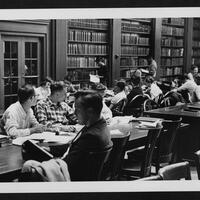
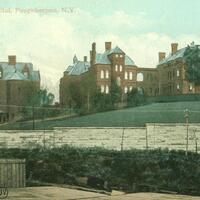
The D'Youville College Architecture, Buildings, & Grounds collection documents how the college campus has changed over the last 100 years. D'Youville experienced a flurry of expansion in the 1950s and 1960s, and many of the buildings harken to the mid-century style. Images include architectural renderings, existing and demolished buildings, proposed buildings, interiors, and broader views of the College's West Side neighborhood.
D'Youville College is an independent Catholic college located in Buffalo, NY. Founded by the Grey Nuns in 1908 and named for their patron Saint Marie-Marguerite d'Youville, D'Youville was the first college in Western New York to offer baccalaureate degree programs for women. D'Youville offers undergraduate, graduate, and professional degree programs in allied health professions, education, business, and liberal arts.
The D'Youville College Archives was established on February 1, 1967, by Sister St. Mary Jones at the request of the College President Sister Francis Xavier Lynch. Since that time, the College Archives has collected and preserved college records, photographs, histories of the Grey Nuns, and rare books.
Scope of Collection
The collection consists of architectural drawings of the campus buildings, as well as photographs of the construction process and completed buildings. The bulk of the collection dates to the late 1950s through 1960s.
Browse within this collection
Browse similar collections


Collection Facts
Historical Context
Before 1946, when a drug based cure for tuberculosis was found, Saranac Lake was a renowned center for the only known way to cure tuberculosis, fresh air and complete bed rest. The Cure Cottages are buildings, mostly still present today, that became private sanatoriums for those sick with tuberculosis.
The Cottages are focused on the fresh air and bed-rest treatment, having multiple porches, balconies, and sunrooms, with enough room to place multiple patients on cots and hammocks.
The Cure Cottage "Cure Porches" were glassed-in rooms that were mainly added on to the house on the ground floor, or were modified from existing house features. These rooms were fitted with sliding glass windows that enabled the air to be regulated within the room. A standard treatment for the patients included at least eight hours resting within the Cure Porch.
Scope of Collection
The collection contains black-and-white photographs of Cure Cottage buildings in the Saranac Lake region. Most of the collection is undated but appears to date from the late 19th century to early 20th century. There are a couple color photographs also included in the collection of a more recent vintage. The images depict views of the buildings, mostly exterior views, but some interior views are present, Most of the buildings are named and have their street noted.
Browse within this collection
Browse similar collections


Collection Facts
Scope of Collection
This collection includes a sampling of menus drawn from the world-renowned CIA Menu Collection, a collection of nearly 40,000 historical menus from over sixty individual collections. Assembled over decades, the collection illustrates the history of dining in America and abroad, with menus from all of the states and over 80 countries, as well as ships, railroads and airlines. The collection includes menus from CIA restaurants and donations from major menu collectors, including the Smiley Family of Mohonk Mountain House, who graciously donated over 900 menus from their personal collection.
Use the links below to explore this selection of menus:
Browse within this collection
Browse similar collections


Collection Facts
Historical Context
History of Amusement Parks
The early pleasure gardens of Europe are considered by historians to be a forerunner of modern amusement parks where the entertainments included theatre shows, firework displays, and dancing and drinking booths. The most noted of these include Vauxhall Gardens (Britain) and Tivoli Gardens (Denmark). The advent of the railway and the arrival of the Industrial Revolution resulted in a renewed popularity of the travelling fairs in the mid-19th century. The traveling fair allowed people from all walks of life to share in the experiences of entertainment. Advances in mass transportation, coupled with the emergence of the private automobile, enabled people to come to the parks rather than the parks coming to the people.
Coney Island in New York was developed as a resort by Paul Boyton, who moved there after the success of the world’s first amusement park, Paul Boyton’s Water Chutes, which opened on Chicago’s South Side in 1894. Inspired by the success of the midway that was part of Chicago’s 1893 Columbian Exposition, this venture used rides as its main attraction, instead of picnic facilities or a lake. The success of Boyton’s Chicago Park encouraged him to open a similar facility at the fledgling Coney Island resort in 1895. By the 1920s, amusement parks could be found across the country in cities large and small. For Buffalonians, crossing Lake Erie for the shores of Ontario was presented as an ideal getaway to the more "healthy and wholesome" lakeshore setting, as well as enjoyment of amusement park rides and attractions.
The Great Depression caused an enormous downturn in attendance at amusement parks and many were forced to close. After WWII, war-weary Americans once again turned to amusement parks for entertainment. Postwar parks included a "Kiddieland" area where families could enjoy rides and games together. New rides were based on war themes (fighter planes and tanks) or futuristic themes (rocket ships and fantasy cars). The bizarre freak shows of the pre-War amusement parks were replaced by the fantasy theme parks of the 1950s, epitomized by the opening of Disney Land in Anaheim, California, in 1955.
Although amusement parks appear to be in decline once again, the resilience of the park owners and operators and their ability to detect the pulse of American ideals will probably create a new direction for this venue of public entertainment.
Early History of Crystal Beach (ca. 1888-1940)
Crystal Beach is located in the township of Fort Erie in the province of Ontario, Canada, along the shores of Lake Erie. Crystal Beach began in 1888 as a Chautauqua show area, or religious campground, with an auditorium, tents, and picnic grounds. It drew 150,000 guests per season. Entrepreneurs saw an opportunity to make money by having side show performances between sermons and to offer refreshments.
A group of investors got together in 1890 and formed The Crystal Beach Company (CBC), as the beach was dubbed by one of the partners because of the sand quality there. The beach was a major attraction because of a gentle slope that ran for some distance underwater with no drop-offs or undertow. Crystal Beach continued to operate until 1989 when the park was closed permanently. It is now the site of a private gated community.
The company installed amusements, built a pier, and started ferry service to the park, which delivered its first customers on July 16th of 1890. The ferry company ran The Dove (500 passenger) and Superior (1200 passenger), for the 1890 season but brought Pearl (800 passenger, later renamed Crystal) in 1891 to meet the growing demand. Other ferries that served the park in its first decade were Gazelle, Puritan (launched 1982), Pilgrim, State of New York, A.J. Timon, Garden City, and Darius Cole. The Puritan unfortunately burned in Buffalo in 1901.
The steamboats that ferried passengers across the lake from Buffalo, NY, to the park were themselves a part of the Crystal Beach experience. In 1910, two more steam ships were added to the fleet, the Canadiana and the Americana, both with dance floors on board, enabling passengers to limber up for dances in the Crystal Dance Hall. The Ontario Southern Railway also provided a short-lived connection between the park and the mainline rail station at Ridgeway. This service consisted of an elevated monorail-style train and ran for only three summers from 1896 through 1898.
A miniature train and a carousel may have been built as early as 1888 or 1889. Sometime around the turn of the century an Armitage-Herschell carousel with rocking horses was installed. Other popular amusements added over the years included roller coasters, fun houses, bumper cars, roller skating rinks, and of course, a midway. To house guests, investors built The Assembly House Hotel, later renamed The Royal, which burned down in 1923. The Crystal Beach Collection features the Bon Air Hotel.
In 1921, a new concrete pier was erected to accommodate increased business. It had a two-story covered section with an open upper observation deck. This upper deck was used to launch fireworks in later years. The pier still exists today.
In 1902 one of the concessionaires was confectioner George Hall. He became famous for his lollipops but later sold candy kisses, caramel corn, peanuts, and popcorn. In 1924 he became president of the Buffalo & Crystal Beach Corporation which purchased the Park in March of that year for approximately $1,000,000. The new owners immediately remodeled the dance pavilion, adding new lighting effects. The incredible 3,500 square-meter maple floor could hold up to 3,000 dancers at once.
The CBC put in Traver Caterpillar and Merry Mix-Up rides, plus an aerial ride. By the 1940s the CBC also came to operate a miniature golf course and other devices in the park. What really put Crystal Beach Amusement Park on the map was the Crystal Beach Cyclone, a wooden roller coaster that opened in 1927. The ride was very intense and according to its fans, was one of the greatest coasters ever made. It closed in 1946 and many of the parts went into the Crystal Beach Comet, another wooden roller coaster that remained until the Park closed. The Comet is now located at The Great Escape and Splashwater Kingdom in Lake George, NY. At its peak in the 1940s and early 1950s the park had about 20,000 visitors daily from Memorial Day through Labor Day.
(Sources: "Crystal Beach Park (1888-1989)", from Coaster Enthusiasts of Canada: Closed Canadian Parks Web site)
Additional Resources
Amusement Park Physics from Annenberg Interactives
Theme Park Related Activities & Lesson Plans
Coaster Enthusiasts of Canada: Closed Canadian Parks
Herschell Carrousel Factory Museum
Crystal Beach Keepsakes
Scope of Collection
The collection spans the dates 1896-1926 and includes several items of ephemera, one newspaper article, and photographic images.
Browse within this collection
Browse similar collections

Collection Facts
Historical Context
Crouse-Irving Hospital, destined to merge with Syracuse Memorial, was founded by a group of physicians and investors under the leadership of Dr. William L. Wallace in 1912. In 1913 Crouse-Irving Hospital School of Nursing was founded. For many years, Syracuse Memorial Hospital and Crouse-Irving Hospital operated separately while being located across the street from each other. The two hospitals merged in 1968 into Crouse Irving Memorial Hospital. Crouse-Irving’s School of Nursing became the Crouse Irving Memorial Hospital School of Nursing at that time. Following the merger, plans were begun to expand and modernize the existing facilities. As part of the S.H.A.R.E. campaign to modernize healthcare facilities in Onondaga County, funds were raised to replace the deteriorating Crouse-Irving Hospital Building. In 1976, the Irving Unit (attached to the Memorial Unit, the former Syracuse memorial Hospital) was opened while the former Crouse-Irving Hospital was converted to an educational building for the hospital the School of Nursing, then demolished in 1991 when the present Harry and Lillian Marley Education Center opened. In June 1996, a new name was announced, changing Crouse Irving Memorial Hospital to Crouse Hospital. In 2015 the Crouse Hospital School of Nursing was renamed the Billl and Sandra Pomeroy College of Nursing at Crouse Hospital.
Scope of Collection
This collection includes selected yearbooks from Crouse Hospital's School of Nursing, as well as its predecessor institutions at Syracuse Memorial Hospital and Crouse-Irving Hospital.
Browse similar collections


Collection Facts
Historical Context
Crouse Hospital’s was founded in 1887 by a group of community-minded women from the Syracuse Women’s Hospital and Training School for Nurses. It was the only hospital in the area at the time that focused on the specific healthcare needs of women and children; still a strategic focus today in fulfillment of the hospital’s mission to provide the best in patient care and to promote community health. In 1902 its name changed to Syracuse Hospital for Women and Children and by 1908 the hospital began to admit men. In 1918, the name was changed to Syracuse Memorial Hospital to reflect its broader range of services. In 1929, the hospital moved to its present location on Irving Avenue. In 1946, after World War II and the establishment of a cooperative arrangement with Syracuse University’s School of Nursing, the Syracuse Memorial Hospital School of Nursing was dissolved.
Crouse-Irving Hospital, destined to merge with Syracuse Memorial, was founded by a group of physicians and investors under the leadership of Dr. William L. Wallace in 1912. In 1913 Crouse-Irving Hospital School of Nursing was founded. For many years, Syracuse Memorial Hospital and Crouse-Irving Hospital operated separately while being located across the street from each other. The two hospitals merged in 1968 into Crouse Irving Memorial Hospital. Crouse-Irving’s School of Nursing became the Crouse Irving Memorial Hospital School of Nursing at that time. Following the merger, plans were begun to expand and modernize the existing facilities. As part of the S.H.A.R.E. campaign to modernize healthcare facilities in Onondaga County, funds were raised to replace the deteriorating Crouse-Irving Hospital Building. In 1976, the Irving Unit (attached to the Memorial Unit, the former Syracuse memorial Hospital) was opened while the former Crouse-Irving Hospital was converted to an educational building for the hospital the School of Nursing, then demolished in 1991 when the present Harry and Lillian Marley Education Center opened. In June 1996, a new name was announced, changing Crouse Irving Memorial Hospital to Crouse Hospital. In 2015 the Crouse Hospital School of Nursing was renamed the Bill and Sandra Pomeroy College of Nursing at Crouse Hospital.
Scope of Collection
The Crouse Hospital History collection contains black & white and colored photographs of Crouse Hospital and the staff and students who resided there from the late nineteenth through twentieth centuries. These photographs include the development of the hospital, its change in exterior over various decades, its services to the Syracuse community, education of nurses, and trends in healthcare delivery.
Browse within this collection
Browse similar collections

Collection Facts
Scope of Collection
This collection contains selected interviews from the Historical Society of Rockland County's radio show, Crossroads of Rockland History, which airs monthly on WRCR radio.
Browse within this collection
Browse similar collections


Collection Facts
Historical Context
The Crane School of Music is one of three schools which make up SUNY Potsdam, and is primarily focused on the education of music teachers. It was founded in 1896 by Julia Etta Crane, and after her death in 1923 it was sold to the State of New York in 1926, wherein it was incorporated into the Potsdam Normal School.
Scope of Collection
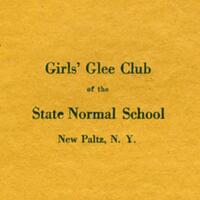
This collection contains photographs, pamphlets, newspaper clippings, and sheet music relating to the history of the Crane School of Music dating between 1869 and 1993. Included are several portraits of Julia Crane, the school’s founder, as well as images of the Institute buildings and of preforming groups.
Browse within this collection
Browse similar collections

Collection Facts
Historical Context
The New York State College of Forestry at Syracuse University was created in 1911. Part of the early educational experience required students to attend a sophomore summer camp located on Cranberry Lake in the Adirondacks. Since the first summer camp in 1915, students would write about their experiences. These memories and pictures were published into an annual yearbook referred to as the “Camp Log.” You can follow the many developments and changes over the years to the summer camp through these Camp Logs. Eventually the summer camp became known as the Cranberry Lake Biological Station (CLBS) and the Camp Logs were included into the College’s Empire Forester Yearbooks.
Scope of Collection
This collection contains yearbooks from the New York State College of Forestry’s Cranberry Lake Biological Station, dating from 1915 to 1938. The titling is inconsistent, either reflecting the class year or year of publication.
Browse within this collection
Browse similar collections

Collection Facts
Historical Context
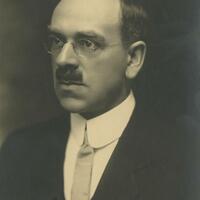
The Crain family resided in the town of Warren in southern Herkimer County (Cullen, New York), and maintained strong political ties and involvement in both New York City and national politics. Born on March 19, 1774, in Weston, Maine, physician Rufus Crain moved from Connecticut, and established a medical practice in Warren, Herkimer County, New York by 1794. In 1798, he married Philatheta C. Marshall from Colchester, Connecticut. Born August 31, 1798, the couple’s son (one son, two daughters), William Cullen Crain, married Warren resident Perses Narsina Tunnicliff in June 1826. The two had seven children (Philotheta Lucetta Crain Bowers,1827; Rufus William Crain, 1829; Dunham Jones Crain, 1831; Charlotte Ranzau Crain, 1835; William Baker Crain, 1883; Bianca Louisa Crain, 1844; and Richard Tunnicliff Crain, 1883). Born April 20, 1838, William Baker Crain served as a Union Army physician and surgeon from 1861 to 1865. Upon his return to Herkimer County in 1865, his father William Cullen passed away. Dunham Jones Crain was born February 28, 1831 in Warren, and married Hannah Ann Crocker on April 25, 1859. Dunham Jones graduated from Union College in 1850, practiced law with the firm Barney and Butler in 1854, and served as a New York State Assemblyman (New York City Fourteenth District) in 1858, and as President Rutherford B. Hayes’s consul in Milan, Italy, between 1877 and 1884. Born the first of seven children (Sarah N. Eliza Crain in 1862, Hannah Ann Crain in 1864, Christobelle Crain in 1867, Dunham Jones Crain II, 1869-1870, Davida Crocker Crain in 1872, and Edith Ranzau Crain in 1874 on May 25, 1860, Hannah’s and Dunham Jones’s son Thomas Crowell Taylor Crain studied law and entered the practice in 1884 with the firms Cochran and Clarke and Kenneson, Crain, and Alling. In 1890, he served as New York City mayor Hugh J. Grant’s private secretary, and earned a position the following February as City Chamberlain until 1893. That same year, he married Agnes Clarke in New York City. From 1904 to 1905, Thomas Crowell Taylor served as City Tenement House Commissioner, as well as the presiding judge over the 1911 Triangle Shirtwaist Fire case. Dunham Jones Crain died on May 17, 1909, and his wife Hannah Ann followed in 1914, while Thomas Crowell Taylor Crain lived until May 19, 1942. Other members of the family included William Cullen Crain II, Alfred Rufus Crain, Alfred Van Rensselaer Crain, and others, including several marriages into Herkimer County and New York City families like the Warrens, Bowers, Taylors, and Crockers.
Scope of Collection
This collection consists of correspondence, photographs, business ledgers, account books, day books, check books, and documents relating to politics, business, foreign affairs, and the family’s personal affairs, which not only offer a glimpse into nineteenth century rural life in New York State, but detail machine politics on a regional, state, and national level into the early twentieth century. Each member of the Crain family penned several letters to each other, as well as to a variety of political and business leaders from New York City, other east coast cities, and overseas. Also present in this collection are a number of business and governmental ledgers, as well as material associated with the Cullen post office and the establishment of the 1892 Church of the Good Shepherd in Cullen. The collection contains various photographs of both immediate and related members of the Crain family. Several published works belong to the collection as well, including a number of religious works and books published by and for New York State government personnel and politicians. Lastly, a variety of assorted personal, business, political, and other topical documents and some physical objects associated with the Crain family’s estate (Cullenwood), New York City real estate business, foreign appointments, finances and payments, and family and friends are present in several folders sorted by year and/or topic.